


Unplanned plant stoppages are among the most costly risks in industrial production. Applications involving cables in constant motion are particularly sensitive: energy chains in machine tools, robot axes in automotive manufacturing or linear drives in intralogistics systems. Here, the connection technology is constantly subjected to bending, torsional and tensile stresses. If an energy or control cable fails, it may be not just a single machine but an entire production line that comes to a standstill.
In practice, two maintenance strategies have dominated to date: either cables are only replaced when damage occurs, or they are replaced as a precaution at fixed intervals – regardless of their actual condition. LAPP, the global market leader for integrated solutions in the field of cable and connection technology, is therefore working on a concept for condition-based maintenance of power and control cables – before it is too late. Under the project name Predictive Maintenance for ÖLFLEX® (PdM4ÖLFLEX), a solution is being developed for the predictive maintenance of ÖLFLEX® brand power and control cables. The aim is to implement condition monitoring during operation, thereby enabling replacement based on actual need.
The basis for this approach emerged from the development project centred on the ETHERLINE® GUARD condition monitoring device, which has been in existence since 2021. The experience gained from this project revealed a gap: whilst data cables can be monitored relatively easily, a solution for traditional power and control cables during operation has been lacking until now.
“We realised early on that the greater leverage lies not with data cables, but with power cables,” says Tobias Heuft, Research Engineer Advanced Technology at LAPP and lead on the PdM4ÖLFLEX development project. “Power-carrying cables are the lifelines of many systems. This is where costly downtime occurs, and this is precisely where the metrological challenge is greatest.”
Measurement under voltage: The technological core
Condition monitoring in PdM4ÖLFLEX is based on Time Domain Reflectometry (TDR). This involves feeding a short electrical pulse into a cable. If this encounters a change in impedance – for example, due to mechanical wear or incipient damage – part of the signal is reflected. The location and nature of the change can be deduced from the transit time and amplitude of the reflection.
“The real innovation does not lie in the TDR measurement itself,” explains Tobias Heuft. “The measurement has been known for decades. The key is that we integrate it in such a way that the cable continues to operate under full operating voltage. We do not need an additional sensor wire or a specially constructed cable.” LAPP has patented the application of TDR measurement for power cables during live operation.
The measurement signal is superimposed on a live cable in a potential-free manner, with special filters ensuring that the low-frequency useful signal remains stable. At the same time, the high-frequency measurement signal is fed into the cable without affecting operation.
During operation, the system regularly transmits short measurement pulses in the nanosecond range. The reflected signals are precisely recorded, analysed with high temporal resolution and digitally evaluated. The system stores the reference profile of an intact cable as early as during commissioning. This baseline profile later serves as a basis for comparison: the electronics continuously check the reflection profiles and compare them with the original condition. A characteristic value is calculated from the squared deviations along the cable length – the so-called cable status. “We not only see that something is changing, but also where it is changing,” says Tobias Heuft. “This allows us to distinguish between uniform ageing and localised damage.”
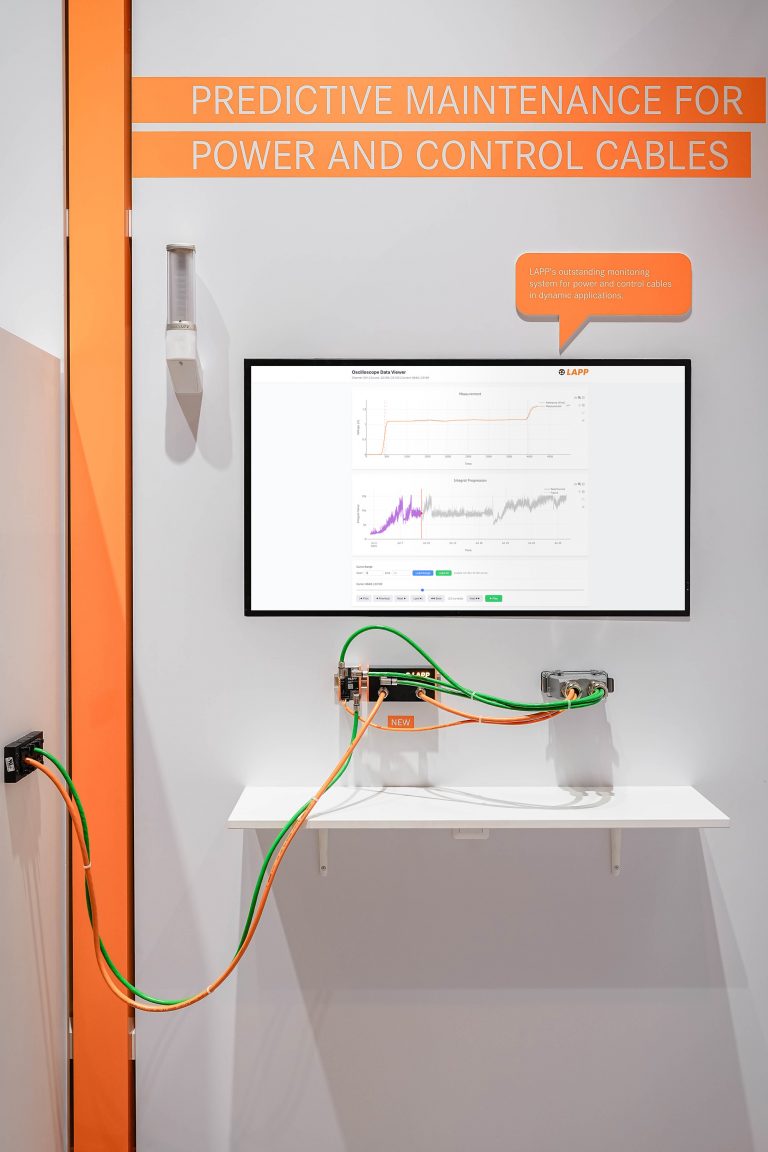
Tangible benefits in day-to-day plant operations
The practical added value is particularly evident in highly dynamic applications. There, power cables can be monitored at an early stage before a conductor break or insulation damage occurs. Replacement can be scheduled during planned maintenance windows to avoid unplanned downtime.
This approach also opens up new possibilities when dealing with cable bundles. In many installations, data, control and power cables run together in a so-called dresspack. If a single cable shows signs of wear, the entire bundle is often replaced. By combining the monitoring of data cables with ETHERLINE® GUARD and power cables with PdM4ÖLFLEX, only the components that are actually worn out could be replaced in future.
This also has an impact on resource usage: cables are not disposed of as a precautionary measure, but are used until they are actually worn out. “If I know the actual condition, I can use a cable for longer and replace it in a more targeted manner,” says Heuft. “This reduces material usage and avoids unnecessary replacement.”
Technically validated – now comes market testing
The concept was first presented in 2025 at the SPS trade fair for automation technology in Nuremberg. As with ETHERLINE® GUARD, LAPP is also presenting PdM4ÖLFLEX at an early stage of development to gather feedback from the field and realistically assess market interest. “We don’t develop products behind closed doors,” emphasises Tobias Heuft. “We want to understand early on how the market perceives the added value. Only then do we decide on the next steps.”
The response to PdM4ÖLFLEX has been mixed so far: interest is not currently widespread. However, there is clear demand in those areas where companies are already working with condition monitoring systems or are facing specific failure issues. “We see two main groups,” explains Tobias Heuft. “On the one hand, companies under acute pressure where cables fail regularly. On the other hand, there are businesses that already collect condition data from numerous sensors and wish to systematically integrate passive components such as cables.” PdM4ÖLFLEX is therefore not aimed at standard applications, but at scenarios with high potential for damage and corresponding economic leverage.
Technical testing is now followed by the industrialisation phase. “The measurement physics work,” emphasises Heuft. “The actual development work now consists of miniaturising the system and converting it into an industrial-grade device.” However, there is one factor that is slowing down development somewhat, adds Heuft with a smile: the LAPP cables used for testing are proving to be exceptionally durable. It will take time before real wear and tear processes become apparent and reliable comparative data is generated.
Ultimately, the economic implications are decisive. Energy and motor cables in demanding environments can quickly reach four-figure costs per hundred metres. Even more significant are the costs of unplanned production downtime. “If the PdMÖLFLEX project prevents just a single instance of unplanned production downtime, such a system can pay for itself in one fell swoop,” emphasises Tobias Heuft.