

With a quiet hiss, the workpiece carrier lowers onto the conveyor line. A sensor detects the positioning signal, and the light on the control cabinet turns green. What at first glance looks like a simple movement is the result of a highly complex interaction between sensors, actuators, cables, and network components. From the first signal to the execution of the conveyor movement, each step is precisely coordinated with the others so that information reliably arrives where it is needed.
The carrier moves on to the next station, where it is loaded with a workpiece – a bar of chocolate. It then glides through various processing stations until the bar is finally dispensed at the removal station. On the fifth pass, a signal sounds: the stack of chocolate workpieces is almost empty. A sensor uses optical distance measurement to detect the need for replenishment and
reports this to the system in real time. In a fraction of a second, the measured value is transmitted via a sophisticated sequence of different cables and network nodes to the cloud, where the information can be retrieved.
There is much more to this chocolate conveyor system from LAPP than just a delicious attraction: it illustrates how numerous sensors and actuators work together in production environments to transfer data from the field level to the cloud and map processes transparently in order to optimize workflows and parameters in a targeted manner.
Nerve pathways for the smart factory
The cloud acts as the ‘brain’ of the smart factory: it controls processes, processes information and coordinates the interaction of all components. But just as the human brain relies on a functioning nervous system to transmit information, the smart factory also needs a powerful communications infrastructure. In the Industrial Internet of Things (IIoT), cables, connectors and active components such as switches and routers perform this task. They are the nerve pathways that transport data securely from the field level to the digital centre, i.e. the cloud.
The journey of the data begins in the sensor: it converts physical measurements into digital information and transmits them via its IO-Link interface. ‘IO-Link is the optimal communication protocol for the field level, i.e. the lowest level of the automation pyramid, where signals are captured and transmitted,’ says Jürgen Greger, Product Manager Industrial Communication at LAPP. In addition to transmitting process values, it also enables diagnostic functions, remote parameterisation and quick device replacement via plug-and-play.
The connection is made via EPIC® M12 connectors and robust sensor/actuator cables such as the UNITRONIC® SENSOR SH M12 from LAPP, which is available pre-assembled in various lengths and is suitable for use in drag chains. Even when replacing old (analogue) sensors with an IO-Link sensor, installers can continue to use existing standard cables with M12 connectors.
Intelligent networking at all levels
At the other end of the cable, EPIC® M12 connectors establish the connection to an IO-Link master such as the UNITRONIC® ACCESS MP08 IOL. The device has eight M12 connections, a power supply and a network connection for output. This is the first time that LAPP has brought active components to the field level. This decentralisation reduces wiring effort and susceptibility to errors, as the sensors no longer need to be wired individually in the control cabinet. Extensive diagnostic options for quick troubleshooting and fault rectification increase system availability.
The IO-Link master bundles the signals from the connected sensors and transmits them to the control level via IIoT protocols. UNITRONIC® ACCESS devices are available as single or multi-protocol variants. The latter support classic industrial Ethernet standards such as PROFINET, Ethernet/IP, EtherCAT, Modbus TCP, CC-Link IE and modern IIoT protocols such as OPC UA, MQTT, REST API and CoAP. The desired communication protocol can be selected directly on the device using a rotary switch; no further software configuration is necessary.
This versatility enables true plug-and-play and provides maximum flexibility for a wide range of applications. The result is a scalable solution that can be integrated into different industrial environments.
At the end of the data chain, an MQTT broker transfers the collected machine data to the cloud. It is usually based on an industrial single-board computer such as an Industrial Raspberry Pi. It receives the data, converts the MQTT telegrams into TCP/IP packets and sends them encrypted and thus securely to the cloud via the network socket. From there, plant operators can access the information remotely – whether for predictive maintenance, quality monitoring or process optimisation.
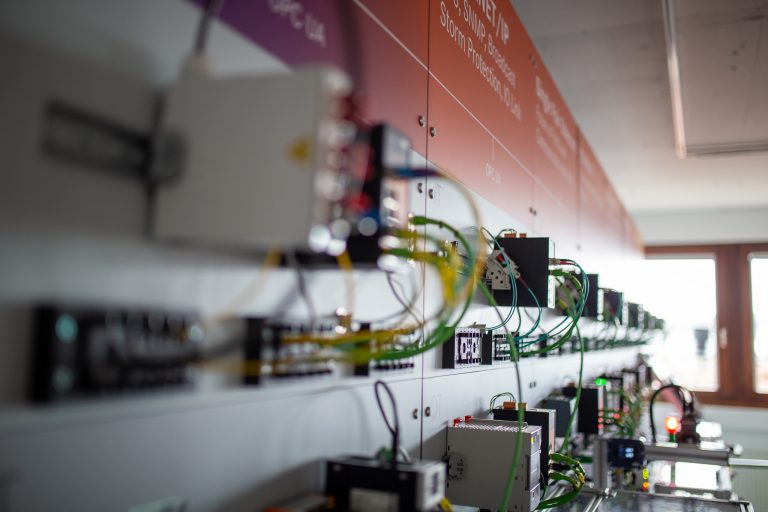
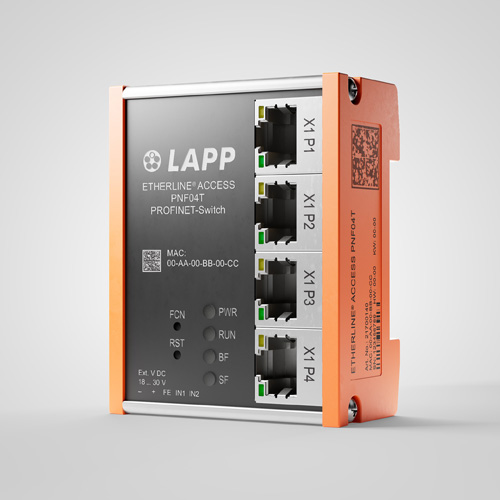
The chocolate conveyor system thus represents the basic structure of a modern communication architecture. In real production environments, where hundreds of sensors and actuators communicate with each other, this is expanded to include additional network levels. Managed switches and routers also coordinate the data flow between the IO-Link master and the MQTT broker. LAPP relies on components such as the PROFINET-certified ETHERLINE® ACCESS PNF switch for stable communication, the ETHERLINE® ACCESS NAT / Firewall for extended protection, and the ETHERLINE® ACCESS Managed Switch with fibre optic connections for high transmission rates of up to 1 Gbit/s and lengths of several kilometres. Patch cables such as ETHERLINE® PN Cabinet Cat.6A for electrical connections or GOF DUPLEX patch cords for fibre optic cables are used to connect the switches. This creates a consistent communication system that grows with requirements and collects and utilises data from playful demo systems to large-scale networked production.
Agility meets experience
The smooth interaction of industrial communication systems requires components that are perfectly matched to each other. As the global market leader for integrated solutions and branded products in the field of connection technology, LAPP offers a complete portfolio that includes not only robust cables and connectors, but also active network components and cloud interfaces.
‘At LAPP, customers receive all active and passive components perfectly coordinated and in proven quality from a single source,’ emphasises Thomas Leitmann, application engineer and certified PROFINET engineer for industrial communication at LAPP. While many suppliers develop their solutions within their own system boundaries, LAPP focuses on customer proximity and flexibility. ‘Our team is agile and at the same time brings decades of expertise in connection technologies to the table. Together with our customers, we find individual solutions even for unusual challenges,’ says Leitmann.
How this works in practice can be seen, for example, in the digital retrofitting of existing systems – so-called brownfield systems. LAPP’s experts often encounter a combination of older components that are to be reused or systems from different manufacturers. Instead of replacing everything, LAPP integrates new products into existing structures. ‘This gives our customers maximum freedom and ensures that they can operate their systems in a future-proof manner,’ emphasises Thomas Leitmann.
Training courses
The LAPP Exploration Center offers you training courses on various topics tailored specifically to your industry requirements.
To the training coursesService offers
We would be happy to advise you individually on the implementation of your industrial communication solution in the LAPP Exploration Center!
To the service offers