

The transition to a more sustainable economy requires a shift in thinking across many areas of a business. Whilst the industry frequently discusses energy efficiency, digitalisation or new technologies, change often begins with a company’s own processes. At LAPP, sustainability is firmly embedded in the corporate strategy. It is one of five overarching objectives of Strategy 2027. By 2027, for example, LAPP aims to reduce its CO₂ footprint at corporate level by 50 per cent (base year 2022, Scope 1 & 2). To this end, the company is expanding its in-house electricity generation using photovoltaics worldwide. At the same time, LAPP calculates the product carbon footprint for all relevant product groups. Individual products are now also available in bio-based variants, which have a lower Product Carbon Footprint compared to the standard versions. Employees worldwide are informed about current developments once a year as part of a sustainability week and are actively involved in projects. In short: sustainability is a major priority for this family-run business, which always has the next generation in mind. There is no shortage of ideas for new approaches.
Now, LAPP is going one step further and converting its entire company car fleet in Germany exclusively to electric vehicles – a comprehensive transformation process that will soon be rolled out across the rest of Europe as well. The measure applies to all company car contracts and pool vehicles and sends a clear signal in favour of future-oriented mobility. In this way, the company can gain valuable insights into the technology behind it, which is becoming increasingly relevant for LAPP as a market. “The systematic electrification of our vehicle fleet is not an end in itself for us, but an economically and strategically sound decision in favour of sustainable mobility,” notes Matthias Lapp, CEO of the LAPP Group. “We are reducing emissions, cutting long-term operating costs, promoting sustainable practices within the company and, at the same time, offering our employees state-of-the-art vehicle technology. That is why it is important to me to take this step now.” With immediate effect, a policy requiring the ordering of exclusively all-electric vehicles now applies in Germany.
From decision to implementation
However, driving an electric vehicle requires not only the right vehicles, but also a safe and reliable charging infrastructure. In May 2026, the Federal Network Agency’s charging register listed 151,452 standard and 52,499 fast-charging points in Germany. A total of 8.75 GW of charging power can be provided simultaneously across all charging points. The charging network is also becoming increasingly dense across the whole of Europe. At LAPP’s headquarters in Stuttgart, more than 50 charging points are already available, and electric vehicle drivers can also recharge at the sites in Hanover, Much and Ludwigsburg. Whilst on the road, drivers head for public charging stations or charging parks. And at home? Here, LAPP is working on the “Laden@home” project, a solution for billing electricity costs when charging at one’s own wallbox. This further increases flexibility.
“We are supporting these transformation processes to ensure that all company car and fleet users feel safe and well looked after,” emphasises Michael Seddig. “The transformation takes time. Together, we are shaping the mobility of the future at LAPP – efficiently, harmonised with and in an environmentally conscious manner.” The CEO and COO for the EMEA region himself switched to a fully electric vehicle at the end of March. “I probably fall into the category of so-called ‘frequent drivers’ and can already say, after just a short time: this was a good decision.”
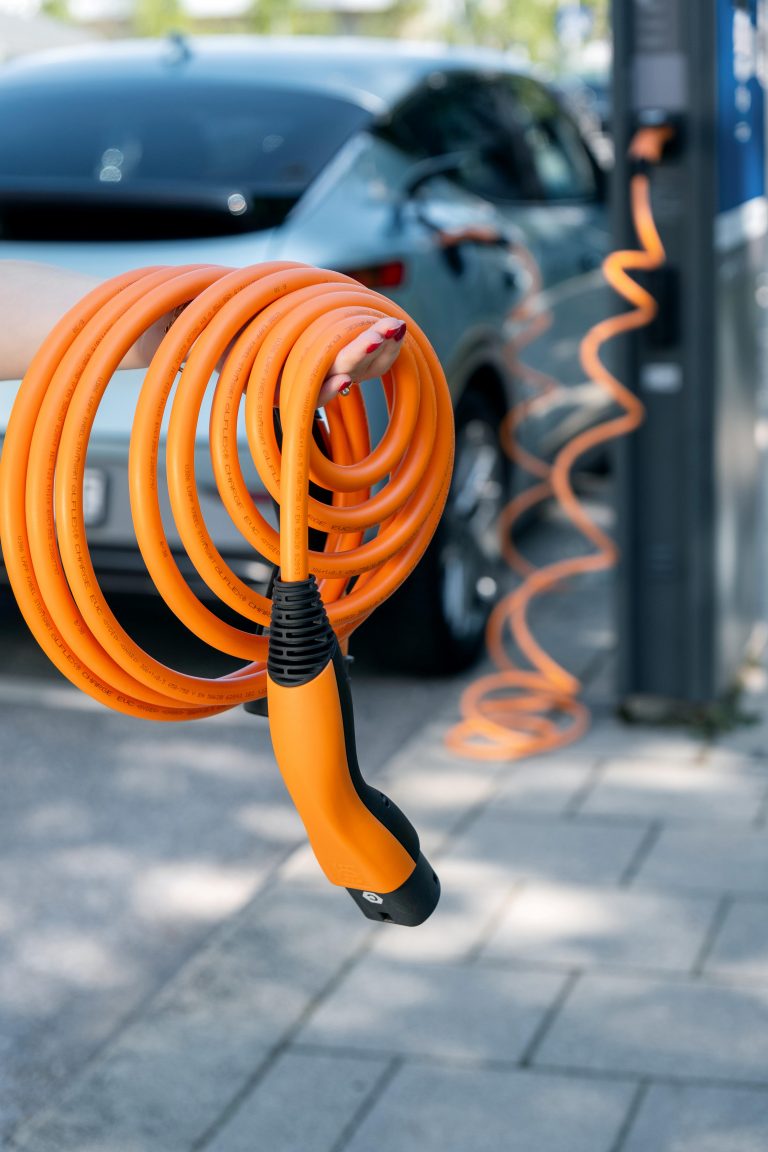
Particularly practical: LAPP can draw on a wealth of expertise and its in-house charging solutions, which have been successfully established on the market for several years now. Lapp Mobility GmbH, a company within the LAPP Group, has specialised in the development and production of solutions for electric mobility for many years. The portfolio includes AC charging solutions such as Mode 3 charging cables for use at charging points and wall boxes, as well as Mode 2 solutions suitable for industry and domestic sockets, and complete solutions for the entire cabling of AC and DC charging infrastructures. Among the most popular products on the market is LAPP’s patented Mode 3 charging cable in its patented Helix design, which, thanks to its shape memory, makes it easy to perform the winding process on its own – say goodbye to cable tangles. Equally popular is the specially developed Mobility Dock, a charging solution for standard earth-connected sockets.
Passed the everyday test
Experience to date shows that electric mobility can work well in everyday working life. Modern vehicles offer sufficient range for most business trips. At the same time, the public charging infrastructure is growing steadily. Of course, the transition also brings changes. Routes and charging times sometimes need to be planned differently to those for vehicles with internal combustion engines. However, many employees report that this new form of mobility quickly becomes second nature. Four LAPP employees share their experiences:

Dirk Eckardt
Key Account Manager für Rolling Stock bei der U.I. Lapp GmbH:
“For me, the car is both a means of transport and a workplace. As someone who travels a lot, I realised early on that electric mobility comes with a certain degree of personal responsibility. It helps you adopt a more sustainable driving style, and you have to head for charging points instead of petrol stations. But this conscious approach is more important today than ever, given the global challenges we face. The charging infrastructure has improved enormously in recent years, and in the regions where I travel, I’ve never had any major problems. Good to know: the range figures for electric cars are misleading. My tip is the 20 per cent rule – subtract 20 per cent from the stated range and, ideally, recharge when the battery is down to 20 per cent. That way, you’re always on the safe side.”
David Schlünz
Project Manager Renewable Energy bei der U.I. Lapp GmbH:
“As a large proportion of my clients work in the renewable energy sector, choosing an electric car was also a conscious decision on my part to project an authentic image. I’ve found that, when driving an electric car, I automatically drive more slowly and no longer try to beat the estimated arrival time shown on the sat-nav. For me, charging stops aren’t a nuisance: I make good use of them to switch off for a moment, check my emails or pop into an organic shop. My personal route planning therefore deliberately includes charging points with cafés or shopping facilities. The pleasant driving experience, the silent and smooth acceleration, and the comfort of pre-conditioning – warm in winter and cool in summer – have made the switch even more comfortable for me.”
Manuel Richter
Head of Digital Business Development Component Sales EMEA bei der Lapp Service GmbH:
As someone who lives in North Rhine-Westphalia, in the heart of a major city, has no way of charging at home and is constantly travelling long distances to client appointments, I actually tick all the boxes for why electric vehicles are supposedly unsuitable. But surprise, surprise: the electric car fits perfectly into my everyday life – despite having to adapt to charging on the go. My golden rule is: ‘If it’s parked, it’s charging’. That means range isn’t an issue. With its spacious interior and the absence of a centre tunnel, the car is a real boon in terms of comfort and a space-saving marvel – which is particularly pleasant on long journeys to visit clients. The charging infrastructure works well almost everywhere, and the excellent acceptance of the charging cards provided by LAPP, both in Germany and abroad, makes planning charging stops much easier. Another little bonus: the service intervals are much longer and the car needs to visit the garage far less often.”

Anke Fröhlich
Team Lead Finance & Corporate Applications bei der Lapp Service GmbH:
“My electric car impresses me anew every day: from the pleasant, quiet driving experience to the instant acceleration with no lag. At first, I had concerns about the range, but charging at the LAPP site in Stuttgart during working hours is more than enough for me – especially in summer, with a range of around 500 kilometres. Driving an electric car has made me drive a bit more slowly and mindfully, which makes the whole driving experience more relaxed, especially in traffic jams. The car is really fun to drive, and the extra effort involved in planning charging is manageable. My tip for those switching over: be sure to watch out for parking fees at some charging stations, as these are often charged for the time the vehicle is parked, even if it isn’t fully charged yet.”