

When discussing cables and wiring, we must first clear up a misunderstanding: whilst both terms are often used interchangeably in everyday language, they differ in technical terminology. Wiring is typically used in buildings, machinery and plant and, depending on its design, can be permanently installed or used flexibly. Cables are generally designed for particularly demanding applications and are suitable, for example, for laying underground, in water or in other challenging environments. However, the clear distinction is determined by the relevant standards and the design of the product. The LAPP experts have compiled an overview of the different types of cables and wires available, where they are used and the functions they fulfil.
Power cables: The foundation of every system
Power cables are used to transmit electrical power. Among the best-known examples are installation cables, such as those used in residential and office buildings for sockets, lighting or switches. In industrial applications, low-voltage cables are frequently used to supply power to machinery, production facilities or distribution boards. Medium- and high-voltage cables are used for power transmission over longer distances, for example in electricity grids, substations or by energy suppliers. The ÖLFLEX® POWER product family was developed by LAPP experts specifically for the transmission of electrical power in demanding industrial environments.
Control cables: the nervous system of machines
Whilst power cables transmit electrical power, control cables facilitate communication within a machine or plant. They carry switching and control signals between control units, sensors and actuators. Typical areas of application are therefore mechanical and plant engineering, conveyor technology and control cabinet construction. Without control cables, individual components would be unable to work together in a coordinated manner. The ÖLFLEX® CLASSIC 110 from LAPP is one of the best-known control cables in mechanical and plant engineering and is used worldwide in a variety of applications.
Data cables: When information flows
With advancing digitalisation, data cables and lines are becoming increasingly important. They transmit digital information between devices, machines and IT systems. Among the best-known data cables are Ethernet cables in the Cat 5e, Cat 6, Cat 6A and Cat 7 categories. They are used in office buildings as well as in production facilities and data centres. In industrial automation, specialised fieldbus cables are also used, such as those for PROFIBUS or CAN bus applications. These enable data exchange between sensors, actuators and controllers. LAPP’s portfolio includes, for example, the ETHERLINE® CAT.6A. This high-performance Ethernet cable enables high data transfer rates and stable communication between machines and IT systems.
Industrial Ethernet: The foundation for Industry 4.0
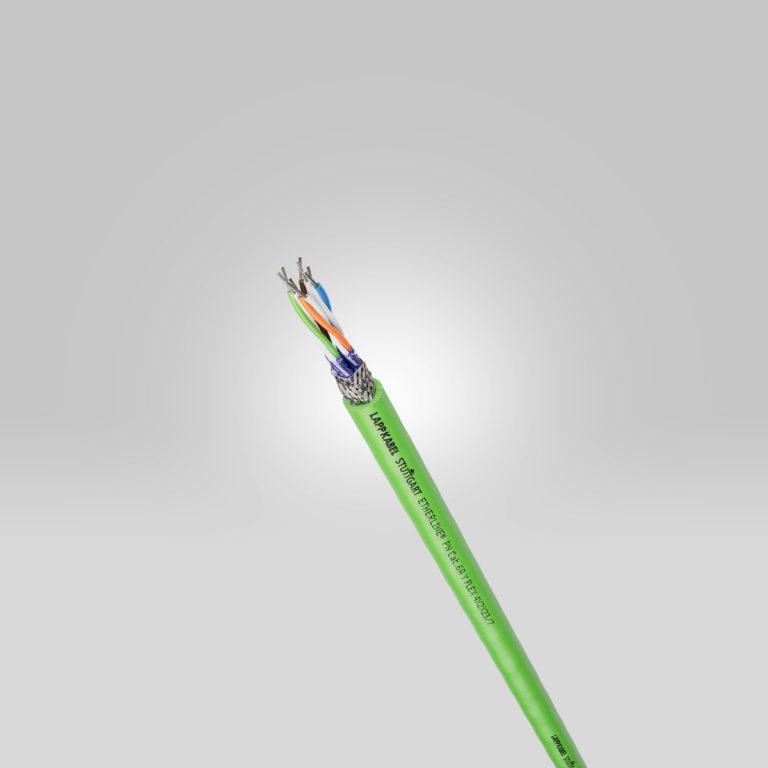
The networking of machines and plant systems gives rise to new requirements for data transmission. Industrial Ethernet cables are specifically designed for use in industrial environments. They must withstand electromagnetic interference, mechanical stress, as well as oil, moisture and temperature fluctuations. They are used, amongst other things, in PROFINET, EtherCAT or Ethernet/IP networks. They form a central foundation for Industry 4.0 concepts and networked production. Overall, this means that Industrial Ethernet cables must withstand significantly higher stresses than traditional office cabling. LAPP’s ETHERLINE® PN cables were developed by the Stuttgart-based connection specialist specifically for PROFINET applications.
Bus cables: communication between multiple devices
Bus cables enable multiple devices to communicate via a shared network. They are used in building automation as well as in machine control systems and process plants. Well-known examples include KNX systems in industrial buildings and fieldbus solutions in industrial automation. For PROFIBUS networks in automation technology, for example, the UNITRONIC® BUS P8 FD offers a robust solution for reliable communication between controllers and field devices.
Fibre-optic cables: High data rates over long distances
Fibre-optic cables are used where large volumes of data need to be transmitted quickly and without interference. Instead of electrical signals, they transmit information using light. Fibre-optic cables offer high bandwidths, long transmission ranges and are immune to electromagnetic interference. They are therefore used in data centres, telecommunications networks, campus networks and, increasingly, in industrial applications. Where high bandwidths and long transmission distances are required, HITRONIC® optical fibre cables from LAPP are used – for example, in industrial backbone networks.
Drag chain cables: Designed for movement
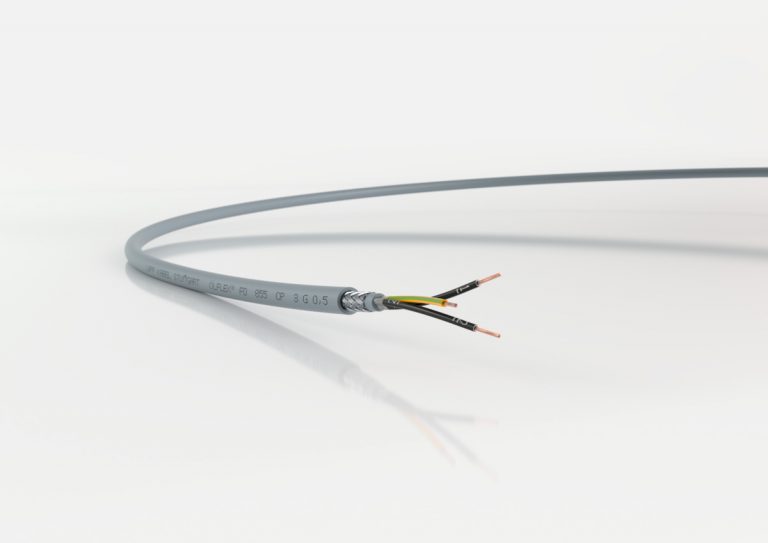
In many machines, cables are constantly in motion. Drag chain cables are specifically designed for this purpose, to withstand millions of bending cycles. They are used, for example, in machine tools, automated storage systems, conveyor systems and handling systems. Their construction prevents premature wear despite constant movement. A tried-and-tested example from this field is the ÖLFLEX® FD 855 CP, which was developed by LAPP engineers specifically for highly dynamic applications in energy supply chains.
Robotics cables: resilient in three dimensions
Industrial robots place particularly high demands on cables. In addition to constant bending movements, they often have to withstand twisting and complex movement patterns. Robotic cables therefore feature special designs that ensure high torsional strength, flexibility and abrasion resistance. They are used in industrial robots, cobots and automated assembly and welding systems. An example from the LAPP portfolio: the ÖLFLEX® ROBOT F1.
Servo and motor cables: Power and precision for drive systems
Modern drive systems require cables capable of transmitting power and, where necessary, control signals. Servo and motor cables connect motors to frequency converters or servo controllers. They play a central role in automated production lines, robotic systems and highly dynamic motion applications. It was precisely to meet this challenge that LAPP developed the ÖLFLEX® SERVO FD 796 CP, for example.
Sensor and actuator cables: The link to the field level
Sensors capture information from the process, whilst actuators implement control commands. Sensor and actuator cables ensure that both communicate reliably with the control system. Today, they are an indispensable part of factory automation, intralogistics and packaging technology. The UNITRONIC® SENSOR M12 from LAPP is particularly widespread. It is usually sold as pre-assembled cable by the metre for sensor and actuator cabling, typically with M8 or M12 connectors from the solution provider’s in-house EPIC® portfolio, and is particularly suitable for flexible and dynamic applications – for example, in mechanical and plant engineering or in intralogistics.
Hybrid cables: More functions in a single cable
Hybrid cables, such as the ÖLFLEX® SERVO Hybrid from LAPP, represent an important trend in automation. They combine various functions in a single cable, such as power supply and data transmission. This reduces the amount of cabling required, simplifies installations and allows machines to be designed in a more compact manner. Hybrid solutions offer significant advantages, particularly in robotics and servo drives.
Specialised cables for specific requirements
Not every environment can be catered for with standard cables. That is why there are numerous specialised solutions for extreme conditions. High-temperature cables, for example, are used in steelworks, foundries and industrial furnaces. Railway cables meet specific requirements for fire and smoke protection. Offshore and marine cables must withstand salty air and moisture. In medical technology, on the other hand, flexibility, reliability and biocompatibility are paramount.
Just as diverse as the applications and environments in our world are, so too must be the connection solutions that are used. It is therefore not uncommon for customers to approach LAPP with very specific requirements that call for a special cable or wire which simply does not yet exist on the market. LAPP’s experts then work with customers to develop bespoke connection solutions. No matter what challenge customers present to LAPP, the Stuttgart-based connection specialist finds a connection solution for every application using coordinated components from its own product portfolio.