

Mr Grünberg, the global rail market is growing rapidly. Which trends and developments are you currently observing most closely?
We are primarily seeing four key developments.
First, rolling stock is becoming increasingly digitalised and equipped with additional functionalities, ranging from passenger information and entertainment systems to air conditioning, Wi-Fi, advanced diagnostics and train control systems. This increases the number of installed components and, consequently, the demand for high-performance cabling. At the same time, however, no additional installation space is available within vehicles.
Secondly, efficiency remains a major focus. Every kilogram saved matters, as reducing vehicle weight lowers energy consumption during acceleration and helps minimise wear and operating costs. As a result, connectivity solutions must become increasingly compact and lightweight without compromising safety or performance.
The third major trend is sustainability. Today, operators and manufacturers are assessing the entire lifecycle of a vehicle much more closely than they did just a few years ago. Factors such as material usage, resource efficiency and carbon footprint are becoming increasingly important in procurement decisions.
And fourthly, the demands placed on onboard data communication continue to rise. High-performance networking and connectivity solutions are therefore becoming ever more critical.
What challenges are currently of greatest concern to rolling stock manufacturers and their suppliers?
Manufacturers today face the challenge of balancing technological innovation, stringent safety requirements and economic pressures. This is particularly demanding in the rail industry, where vehicles remain in service for decades while also being required to meet the highest standards of reliability and interoperability.
At the same time, external factors are affecting the entire sector. Global supply chains have become significantly more vulnerable due to geopolitical crises. Meanwhile, international competition is changing: new market entrants, particularly from Asia, are increasing cost pressure and influencing the procurement strategies of many rolling stock manufacturers.
In parallel, regulatory requirements continue to grow. New standards and country-specific approval requirements must already be considered during product development. For suppliers, this means delivering innovative and cost-effective solutions that meet a wide variety of technical and legal requirements across global markets.

From the perspective of a connectivity solutions provider, what distinguishes the rail industry from other sectors?
The rail industry is one of the most heavily regulated industries in the world. The reason is simple: passenger safety is always the highest priority. Accordingly, all installed components, including connectivity solutions, must meet exceptionally demanding requirements. National and international standards define many product characteristics in great detail, particularly in areas such as fire protection. While this makes product development more challenging, it also ensures the highest levels of safety and reliability. For us, this means maintaining a very broad portfolio capable of meeting diverse technical requirements and international standards.
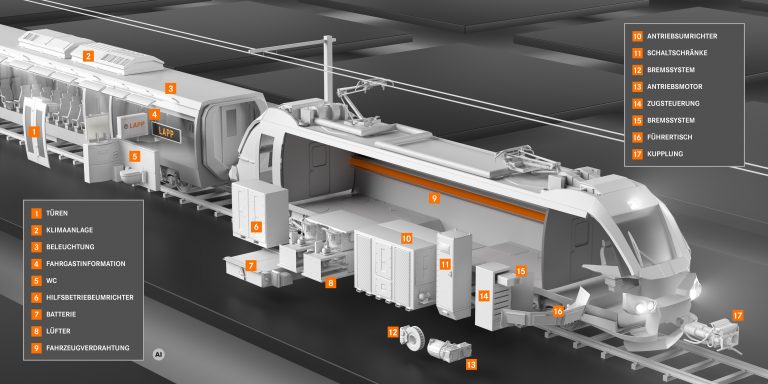
In addition, connectivity solutions must operate reliably for decades, often under extreme conditions. They are continuously exposed to vibration and mechanical stress, must withstand oils, cleaning agents and other chemicals, and must function reliably in both intense heat and extreme cold.
What role do global development, production and supply structures play in international rail projects?
Global development, production and supply structures are now a decisive success factor for international rail projects. Many countries increasingly link public tenders to so-called local content requirements. This means that a significant share of value creation must take place within the respective market. Consequently, it is essential to establish international production capacities and supply chains while reliably meeting regional requirements.
Equally important is close international collaboration in development. This enables regional standards and market requirements to be considered at an early stage while combining technological expertise from different markets.
At the same time, resilient supply chains are becoming increasingly important. Geopolitical crises, disrupted transport routes and rising logistics costs have demonstrated how critical flexible production and delivery capabilities are. This is why we rely on a global footprint combined with close regional proximity to our customers. This allows us to support international projects reliably while responding effectively to local requirements.
How does LAPP create tangible added value for customers in the rail industry through its solutions portfolio?
Our customers benefit above all from the fact that we offer much more than individual cables. Our portfolio covers almost the entire range of connectivity technology, from cables and conductors to cable glands, cable protection and marking systems, as well as connectors and pre-assembled solutions. This enables us to provide complete connectivity solutions from a single source for a wide range of applications.
Small and medium-sized system suppliers in particular benefit from consolidating their purchasing activities and reducing the number of suppliers they work with. Another advantage is our warehousing strategy: many products are available at short notice, allowing even smaller quantities to be delivered quickly. This increases flexibility and helps customers avoid excessive inventories and surplus materials.
Large rolling stock manufacturers, on the other hand, have different priorities. They generally source components from highly specialised suppliers. For them, reliable delivery performance, the ability to provide customised products for project business, and dependable management of complex procurement programmes are especially important. Our processes are designed specifically to meet these requirements.
A further advantage becomes evident in international rail projects. Thanks to our global development, production and supply network, we can reliably accommodate regional requirements, local content regulations and complex logistics concepts. This allows us to support our customers worldwide, from development through to on-time delivery.
What developments will shape the rail industry in the coming years, and how is LAPP preparing for them?
Over the coming years, the rail industry will be shaped primarily by two developments. Sustainability will remain a key driver of innovation. At the same time, manufacturers will realign their sourcing and production strategies. Balancing regional value creation, supply reliability and cost-efficient manufacturing will become one of the industry’s central challenges.
We are preparing accordingly. For example, we have expanded production capacity in India to better support customers locally and meet regional requirements. At the same time, we are evaluating the expansion of additional manufacturing capacities in Europe to strengthen supply chain resilience and produce closer to our customers. In this way, we combine the advantages of a global organisation with the flexibility of regional value creation.