

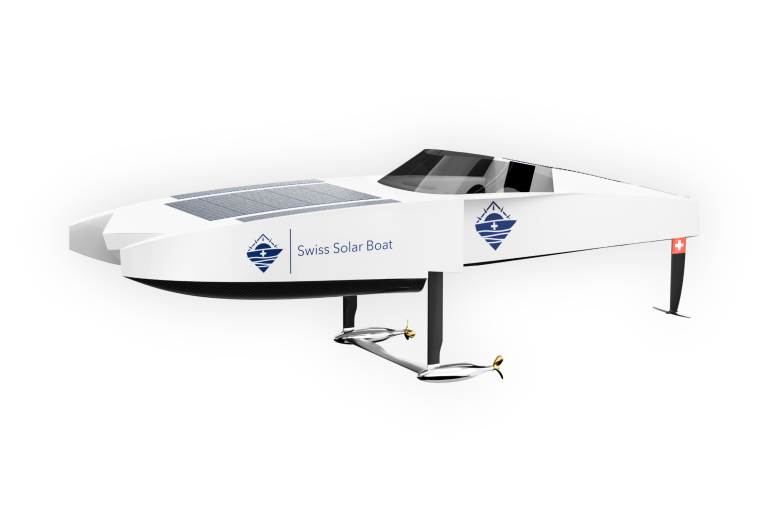
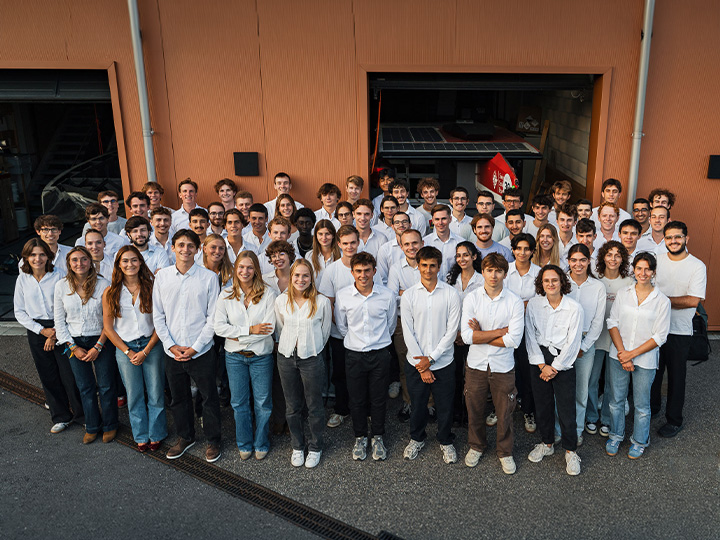
Waterborne mobility is becoming increasingly important – whether in tourism, recreational sports or as an alternative to road transport. The Swiss Solar Boat (SSB) project by EPFL MAKE, an initiative of the Swiss Federal Institute of Technology in Lausanne (EPFL), demonstrates the role that innovative propulsion technologies could play in this context. Together, 75 students developed the Renewable Energy Foiler (REF), a hybrid boat powered by solar and hydrogen. In doing so, they demonstrate how alternative propulsion technologies can open up new prospects for maritime mobility.
From the ‘Dahu’ foiling proa to the Renewable Energy Foiler
The history of the Swiss Solar Boat (SSB) project is marked by technological milestones. One particularly outstanding project is ‘Dahu’, a foiling proa whose unusual name is derived from an Alpine mythical creature and alludes to the boat’s asymmetrical design. As a so-called proa, Dahu is modelled on traditional Polynesian outrigger canoes and combines this concept with foiling technology.
‘Dahu’ won the ‘Eco-Conception Award’ at the Monaco Energy Boat Challenge in 2021 and secured first place in the ‘Championship Race’ a year later. In 2024, the team demonstrated the technology’s practical viability when ‘Dahu’ crossed Lake Geneva from Lausanne to Évian. In doing so, the boat demonstrated how hydrogen can be used as an energy source for propulsion systems on water. With this success, “Dahu” laid the foundation for SSB’s next project – the Renewable Energy Foiler (REF).
Consistently refined
The “REF” is a technological advancement of “Dahu”. In this three-person boat, the hydrogen propulsion system is supplemented by solar energy. The concept thus combines two alternative energy sources in a hybrid propulsion system. Swiss Solar Boat has set a top speed of 35 knots (65 km/h) and a range of around 200 kilometres as technical targets for the REF. Once completed, these figures are to be tested on Lake Geneva.
The “REF” has been under construction since summer 2024 and is now entering the crucial phase of electronic integration. The aim of the project is clear: in the spring, the REF is set to glide across the lake against the breathtaking backdrop of the Swiss Alps and be showcased on the international stage at the Monaco Energy Boat Challenge 2026.
Challenges Overcome
One of the key challenges in developing the Swiss Solar Boat was selecting a suitable CAN communication cable that met the project’s high technical requirements. The cable not only had to have 2 or 4 conductors and be well shielded against interference, but also have a sufficiently thin outer diameter to fit easily into the boat’s cable connectors.
These specific requirements significantly limited the available options. However, with the support of the experts at LAPP SWISS AG, a suitable solution was found. LAPP supplied one of the few cables that met all the technical criteria.
In addition to the CAN communication cables, other LAPP products were used. Cable glands in various sizes were used to route the cables securely through the boat’s bulkheads whilst ensuring a watertight seal – a crucial requirement for reliably protecting the sensitive electronics from external influences. Furthermore, cable lugs played an important role by reliably connecting the boat’s high-current components to the electrical system. Thanks to the reliable and prompt delivery of the required components, the project was able to proceed without any significant delays.
A key to success – strong partnerships
Innovations such as the Swiss Solar Boat do not come about in isolation. Industry partners such as LAPP made a significant contribution to the project by providing key components for its technical implementation. The close collaboration between the university and industry made it possible to develop and test innovative ideas under real-world conditions.
The project is driven above all by the commitment of the students, who bring their creativity, pioneering spirit and technical expertise to the development of the Renewable Energy Foiler (REF). By combining foil technology with a hybrid propulsion system based on solar energy and hydrogen, they are demonstrating the potential of alternative propulsion concepts for shipping – and offering a glimpse of what mobility on the water might look like in the future.